
    Laboratory bench with a pipette and a rack of clear glass vials under cool blue light

    Immune Restore

    The science, without the pitch

    This page explains the mechanism the program is built on, including the parts that are well established and the parts that are not. If you only read one section, read the last one.

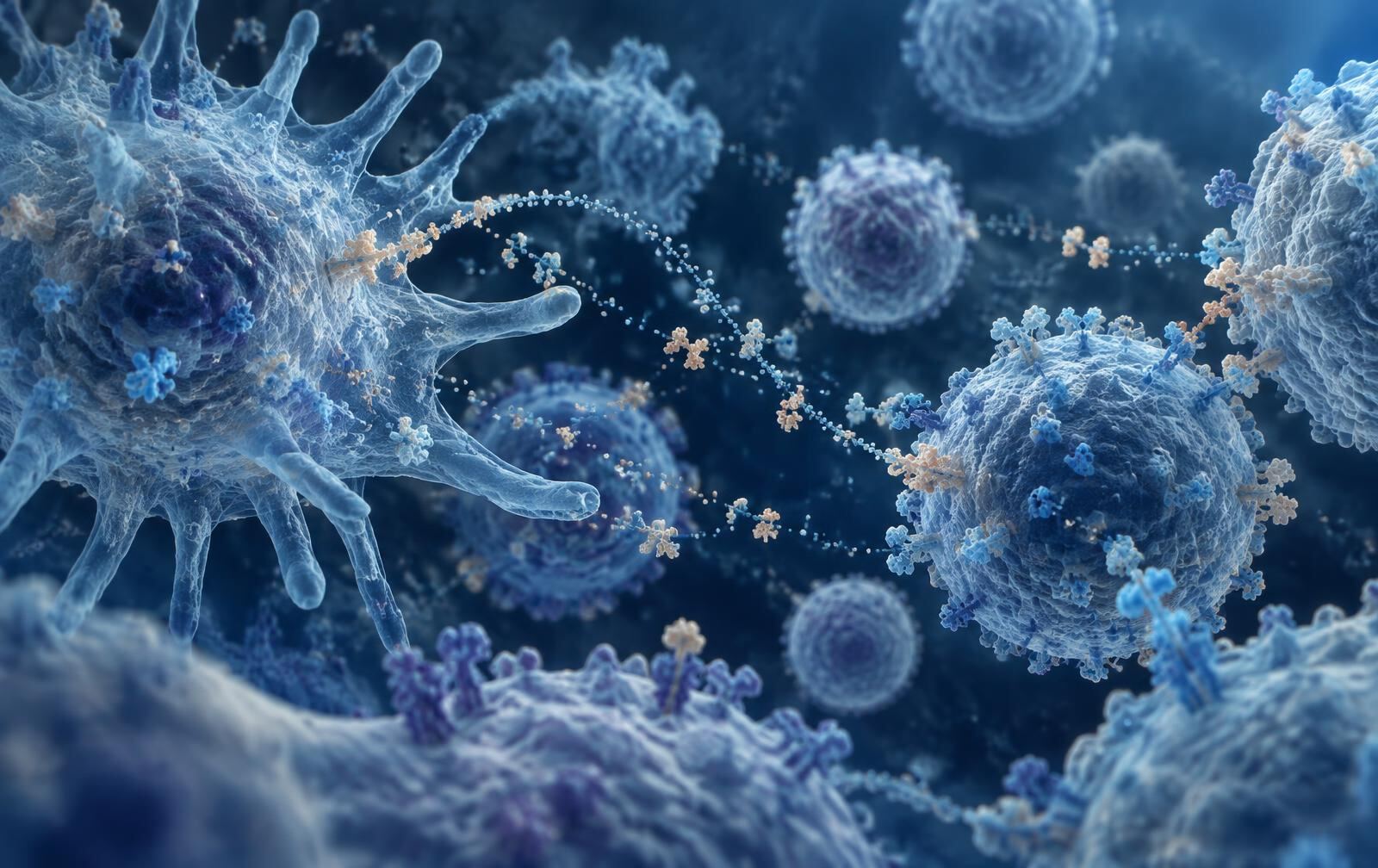
    Scientific visualization of immune cells exchanging molecular signals
    Immune function depends on coordinated signalling between cells—not simply more or less immune activity.

    You have two immune systems, and they have to agree

    Innate immunity is the inherited, immediate line of defence. It does not need to have met a threat before to respond, and it is the part that produces the heat, swelling and fatigue of an inflammatory response.

    Adaptive immunity is the learned, specific arm. It identifies a particular pathogen, mounts a targeted response, and keeps a memory of it so the next encounter is faster.

    In chronic disease the problem is rarely that one of these is simply weak. It is that the two are no longer coordinated: the innate arm stays switched on, and the adaptive arm either misreads targets or fails to signal that the threat has passed. Treating that as a strength problem — pushing the immune system harder — tends to make it worse.

    Acute inflammation heals. Chronic inflammation degrades.

    Acute inflammation is a repair mechanism. It brings immune cells to injured tissue, clears damage, and resolves. You want it, and any intervention that blunts it indiscriminately is trading tomorrow for today.

    Chronic inflammation is the same machinery that failed to switch off. Weeks become years, and the tissue that inflammation was meant to protect is the tissue it begins to damage. This low-grade, persistent state appears across cardiovascular disease, metabolic disease, autoimmune conditions and neurodegeneration — which is why "inflammation" shows up in the mechanism of so many unrelated-looking diagnoses.

    The therapeutic question is therefore not how to suppress inflammation, but how to restore the off switch while leaving the on switch intact.

    Most of this is a signalling problem

    Immune cells coordinate through cytokines and other messengers — a signalling network with amplifiers, brakes, and instructions for programmed cell death. When that network is accurate, a response escalates, resolves, and stands down.

    When signalling is dysregulated, the instructions arrive garbled: cells that should stand down keep recruiting, cells that should be cleared survive, and tissue repair never completes. Regulatory signals such as IL-10 are part of how the body normally closes an inflammatory episode.

    Reading signalling accurately is exactly what the Kure diagnostics exist to do. It is also why a program aimed at signalling has to be measured rather than assumed.

    Modulation is a different category from stimulation or suppression

    Many immunotherapies act from the outside on a chosen target: stimulate this pathway, block that receptor. Their effects and limitations vary by treatment, and pushing one pathway can carry risks that require careful clinical monitoring.

    Immunomodulation aims at something different: engaging the body's own regulatory mechanisms so that the response is re-balanced rather than driven. The intent is adaptability — the system reads its own state and adjusts, rather than receiving a fixed instruction.

    This distinction is the reason the program is framed as restoration rather than escalation. It is also a mechanistic rationale, not a claim of superiority or of proven results in any condition.

    The gut is not a side quest

    A large share of immune tissue sits in and around the gut, and the barrier separating gut contents from that tissue is a single cell thick. When that barrier and the microbial terrain behind it are disordered, the immune system receives a constant stream of signals that something is wrong.

    This is why gut assessment sits inside the program rather than beside it, and why nutrition, drainage and microbial terrain are treated as part of the intervention. Attempting immune restoration on top of an inflamed gut is working against yourself.

    Natural and synthetic peptides behave differently

    Peptides are short chains of amino acids that act as biological messengers. Peptides closely resembling the body's own tend to be well recognised by existing receptors and clearance pathways.

    Synthetic analogues can be engineered for potency or durability, and that engineering is sometimes exactly what a condition needs. It can also increase the chance of an unintended immune response to the molecule itself.

    Neither category is inherently safe. Both require monitoring, and the program treats them accordingly.

    Response shape matters as much as response size

    In immunotherapy generally, early change does not always look like improvement. An immune response arriving at a target can transiently increase inflammation, swelling or measured burden before those measures fall — a pattern documented in oncology and one reason immunotherapy response criteria differ from those used for cytotoxic drugs.

    This is why we do not judge a course by how week two feels. It is also why anyone entering the program is told in advance what early change may look like, what is expected, and what is a reason to call us immediately.

    What the evidence base is, and is not

    The mechanistic literature on immune regulation, cytokine signalling and chronic inflammation is large and well established. That literature supports the reasoning behind this program.

    Evidence quality varies across immune-modulating approaches, so the program does not treat mechanism alone as proof of an individual result.

    Case observations can surface responses and generate useful questions, but they are not proof of effectiveness. That is why every participant is measured objectively before and after, and why those measurements are recorded whatever they show.

    For clinicians and researchers

    Protocol structure, dosing, monitoring and escalation criteria, and case observations sit behind a clinician sign-in rather than on an open page. Licensed physicians and researchers can review them and co-manage patients with our clinical team.

    Install Kure Health

    Add to your home screen for fast access.

    How to install

    • Android / Chrome: tap the menu → “Add to Home screen”.
    • iPhone / Safari: tap the share icon → “Add to Home Screen”.

    Cookie Preferences

    We use cookies to improve your experience and analyze site traffic. Learn about our cookie policy