Liver and kidney filtration: supporting the organs that do the quiet work
8 min read · Updated September 21, 2026
The short answer
Your liver processes compounds in two phases and your kidneys filter roughly 180 litres of fluid daily. Bitter herbs such as dandelion root, milk thistle, burdock and artichoke leaf are traditionally used to support bile flow and filtration. No tea detoxifies an organ — support means reducing the load and supplying what the pathways need.
What filtration actually involves
The liver handles compounds in two broad phases. Phase one converts them into intermediates, several of which are more reactive than what you started with. Phase two conjugates those intermediates — attaching molecules that make them water-soluble so they can leave via bile or urine.
That sequence explains why order matters so much. If phase one runs hard and phase two cannot keep pace, you have generated reactive intermediates with nowhere to go. It also explains why bile flow and bowel movement matter: material excreted in bile that sits in a sluggish bowel gets reabsorbed.
The kidneys filter something on the order of 180 litres of fluid a day, reclaiming nearly all of it and concentrating what leaves. Their requirements are unglamorous: adequate water, adequate blood pressure, adequate minerals, and not being asked to handle an unnecessary chemical load.
The herbs traditionally used
Bitterness is the through-line. Bitter taste receptors trigger bile release, and bile is both a digestive fluid and an excretion route.
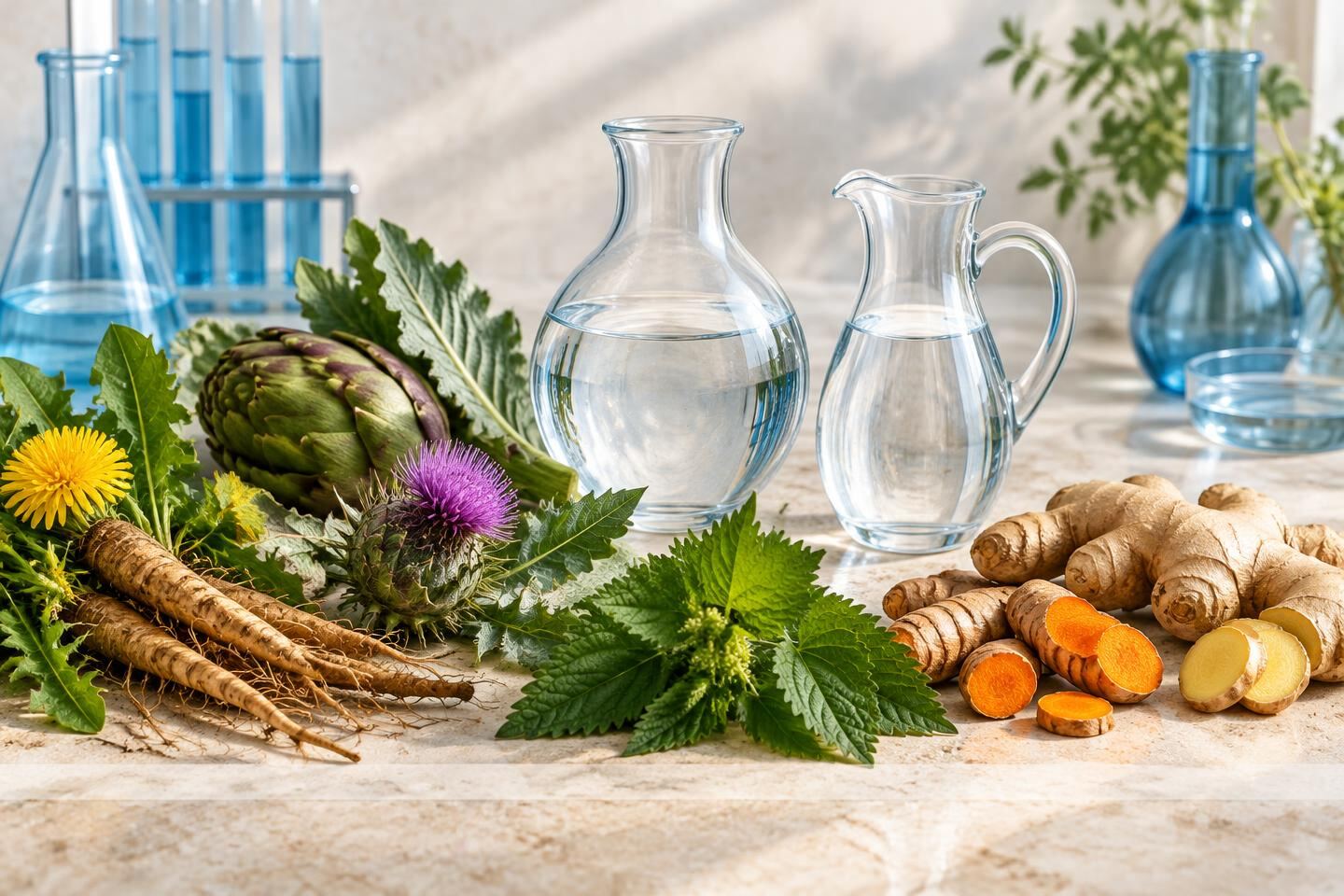
- Dandelion root — the classic bitter for bile flow; dandelion leaf leans more toward fluid balance.
- Milk thistle — the most researched liver botanical, studied for its effect on hepatocyte membranes.
- Burdock root — bitter and mucilaginous, supporting bile and bowel together.
- Artichoke leaf — traditionally used for bile flow and digestive comfort after fatty meals.
- Schisandra — an adaptogenic berry with liver-support research behind it.
- Nettle leaf — mineral-rich, traditionally used for gentle kidney and fluid support.
- Turmeric and ginger — bile-supportive and warming, easy to use at food doses daily.
What support means, and what it does not
A tea does not detoxify your liver. Your liver detoxifies; the question is whether the conditions let it work well. Genuine support is made of four things: reduce the incoming load, supply the nutrient inputs the pathways depend on, keep bile moving, and keep the bowel eliminating so nothing recirculates.
In practice that means less alcohol, fewer ultra-processed foods, fewer fragranced and plasticised products in your home, enough protein to supply the amino acids phase two consumes, plenty of colourful vegetables and cruciferous plants, adequate water, and a daily bowel movement. Bitters and supportive herbs sit on top of that foundation. They do not replace it.
This is also why environmental load belongs in the conversation. If you are working hard on filtration support while continuing to breathe, absorb and eat a heavy chemical burden, you are bailing while the tap runs. Auditing the load is usually the higher-yield move.
What to measure
Filtration is one of the areas where you do not have to guess. Liver enzymes, bilirubin and GGT, kidney markers including creatinine, eGFR and cystatin C, urinalysis, and a broader functional panel will tell you how these organs are actually performing.
Inside a Kure programme those readings are part of your signal map, and they are what your care team uses to decide whether a support phase should run three weeks or eight — and whether a stronger protocol is appropriate at all.
Two firm cautions. Diagnosed kidney or liver disease is not a self-management category; work with your specialist before using any of this. And stop all botanicals at least two weeks before scheduled surgery, telling the surgical team what you have been taking.
This article is general wellness education. It is not medical advice, and the products discussed are not intended to diagnose, treat, cure or prevent any disease.
Before you start anything here
Read the safety guide, and have your provider review your medication list. Pregnancy, breastfeeding, kidney or liver disease, bleeding disorders and several medication classes all change what is appropriate.
Herbal use & safetyQuestions people ask about this
Measured, not guessed
How we know whether a routine is working
Most of this category asks you to judge a cleanse by how you felt on day four. We do it the other way round. Kure reads the systems these routines support before you start and again after you finish, so the answer comes from your own data instead of a testimonial.
Diagnostics describe patterns in your own data. They are not a diagnosis, and Kure Essentials products are not intended to diagnose, treat, cure or prevent any disease.
Who wrote this
Jocelyne · Herbalist, Kure Essentials family
Jocelyne formulates the herbal blends in the Kure Essentials family. Her work comes out of a family tradition of plant medicine, decades of hands-on practice with clients, and a hard line on sourcing: whole herb, no fillers, nothing she would not give her own family.
- Herbal formulation
- Traditional preparation
- Sourcing and testing
Reviewed by Kure Clinical Team
Our clinicians and health coaches review every Kure Essentials guide against the same standards we use inside patient care: what the evidence supports, what it does not, and what we would actually tell a patient sitting in front of us.
How Kure reviews contentThe matching sequence
Filtration Support
Liver and kidney support for people mid-programme, post-IV, or carrying a heavy environmental load.
See the packageShop the shelf
Herbal Teas
Whole-plant infusions for the systems that clear, calm and restore.
Browse herbal teas